Showing posts with label First Peoples Issues. Show all posts
Showing posts with label First Peoples Issues. Show all posts
11.27.2008


9.17.2008
Miss Navajo: Reconceptualizing Native American Beauty
Cross-posted from The Blog and the Bullet.
Renee blogs:
Renee blogs:
Yolanda Charley, recently won the title of Miss. Navajo Nation. I am normally against beauty contests, as I see them as nothing more than the performance of femininity for the male gaze. The Miss Navajo Nation is like no other pageant I have ever come across.
...
What I love about this contest is that it is more than women parading around with fake smiles, with their bathing suits taped to their skin, to avoid being swallowed by their asses. Miss Navajo is about celebration, and the perpetuation of culture.
9.12.2008
The Native Media and American Politics
Cross-posted from The Blog and the Bullet.
The Angry Indian blogs on Native American news outlets:
The Angry Indian blogs on Native American news outlets:
We were never meant to be a part of the colonial system and I find it embarrassing that those who are chosen to represent us do not have the courage to speak about this in real, coherent and tangible terms. Instead, we talk of what it like for Indians to be a part of the DNC and RNC conventions and who got to speak before large crowds and which “tribe” will adopt a candidate who in the end will do absolutely nothing for our people but keep us in our respective place at the bottom of the U.S. totem pole. And we ask ourselves why we get so little respect.
2.06.2008
A Cross-Section of Americana: Analysis
So what do all these Super Bowl ads tell us about America and race relations. Well, for one, despite all this talk about being color-blind, which is what most people say they are when it comes to "viewing" or talking about race, we can see that America, is in fact, not color blind. If whites were truly color blind (and the rest of America for that matter) these commercials would make no sense.
"Huh, pandas? I don't get it. Just pandas speaking plain old English."
"What does a shrunken head have to do with that man in face paint? Weird?"
"Why is a mariachi band playing right now?"
Etc.
The one subject that really binds all of these commercials is "foreigness," as all ads feature foreigners whom are people of color and whom have "funny" and "weird" accents (save the Latino from the Taco Bell commercial). One thing about their accents is that they are supposed to be at the expense of the person with the accent; especially the commercial in where Carlos Mencia is teaching "his buddies" on how to pick up "American" chicks (cause, you know, America women totally don't have accents). We are supposed to laugh at them because they do not speak English "properly" and/or speak it with a "funny" accent.
One thing that is bothersome about the "funny" accent bit is who has the funny accent and who doesn't. Having a French or Italian accent is sexy, having an English accent means you are smart, and having a upper class Spanish (from Spain) accent is also sexy and "exotic." While the sexy and intellectual accents are solely confined to Europe the weird and funny accents are confined to people of color (save that one Russian dude). Having an Indian accent means you are a nerd, having a Chinese accent means you are stupid.
I remember Amy Tan talking about how smart her mother was but because she had a Chinese accent many would mistaken her for dumb and when she would talk to sales reps over the phone or tried to do business with others over the phone Mz. Tan would have to eventually cut in and talk for her (or even pretend to be her with her mother whispering in her ear what to say) in order for her mother to be taken seriously. Again, English accent, "Oh sooooo smart!" Chinese accent, "God! Can't you understand anything I'm saying!"
Of course there were the two SalesGenie.com ads. The thing about these two ads is that they involved no research on Indian or Chinese culture and language. All they were was a bunch of stereotypes taken from memory and written down on paper. The Indian guy had to have an accent and had to have a bunch of kids and had to work in a cubicle under a white boss. The pandas had to have Chinese accents, use bamboo font for their signs, and they had to own a small business. There was nothing really to these ads. They didn't really have any jokes and no points. The could have easily used different ethnicities (or the same) in similar situations and nothing more. But they instead decided to opt for two "foreigners" in their ads that came straight out of a Simpsons cartoon and a yellow face movie. The writers views of Asians weren't from first hand experience (obviously, though not that that would help them) but instead through popular culture such as TV shows, commercials, and movies.
The other one (more than likely) shows a First Nationer with stereotypical body and face paint, a grass skirt, something frilly on his head, and a wood cane. This is one stereotype that I have blogged about before as Hollywood producers and writers (whether it be for TV shows, commercials, movies etc.) can't seem to get away with portraying First Nation natives as anything more than blow darting, human eating, primitive sub-humans. And almost always for comedic affect. Not only that but in the commercial for Cars.com contrasts the half-naked native with well clothed intelligent whites in their modern (and convenient) building.
These of course aren't all of the ads but this little snipit of the ads tells us a lot. America is considered a "National holiday" by many; a day were all Americans sit down at the tube and watch, what is considered, America's sport (sorry baseball). Super Bowl ads also reflect America. They are big-money corporations spending top dollar to make sure that (1) were are entertained by their commercials, and (2) that we (most importantly) buy their products. And of course the media obliges to this by constantly showing us news stories about the upcoming Super Bowl commercials. So you've got many things here that show us America: food crazed, sports hungry fans being bombarded by greedy money grubbing capitalists looking to turn a simple procedure of supply and demand economics into a spectacle.
So if anything these ads are supposed to appeal to a wide swath of Americans; or, more precisly, what corporate America thinks Americans are, which is normally 18 to 35 year old beer guzzling, sex crazed, comedic starved white males.
What we saw in these ads was very much the underlying popular image of race in America. One that views Asians as either hard working and/or slightly dumb with funny accents, natives that shrink you head, "pathetic" and nerdy foreigners with "hilarious" accents (what's up with the African dude and the chicken?), and Latinos meant to entertain us hard working uptight whites.
The one thing to keep in mind with this is that these ads didn't invent or come up with these stereotypes. What they did was use the stereotypes already circulating in pop culture; they essentially plucked the first stereotypical thing that came to their mind and tried to make it into popular entertainment.
"Huh, pandas? I don't get it. Just pandas speaking plain old English."
"What does a shrunken head have to do with that man in face paint? Weird?"
"Why is a mariachi band playing right now?"
Etc.
The one subject that really binds all of these commercials is "foreigness," as all ads feature foreigners whom are people of color and whom have "funny" and "weird" accents (save the Latino from the Taco Bell commercial). One thing about their accents is that they are supposed to be at the expense of the person with the accent; especially the commercial in where Carlos Mencia is teaching "his buddies" on how to pick up "American" chicks (cause, you know, America women totally don't have accents). We are supposed to laugh at them because they do not speak English "properly" and/or speak it with a "funny" accent.
One thing that is bothersome about the "funny" accent bit is who has the funny accent and who doesn't. Having a French or Italian accent is sexy, having an English accent means you are smart, and having a upper class Spanish (from Spain) accent is also sexy and "exotic." While the sexy and intellectual accents are solely confined to Europe the weird and funny accents are confined to people of color (save that one Russian dude). Having an Indian accent means you are a nerd, having a Chinese accent means you are stupid.
I remember Amy Tan talking about how smart her mother was but because she had a Chinese accent many would mistaken her for dumb and when she would talk to sales reps over the phone or tried to do business with others over the phone Mz. Tan would have to eventually cut in and talk for her (or even pretend to be her with her mother whispering in her ear what to say) in order for her mother to be taken seriously. Again, English accent, "Oh sooooo smart!" Chinese accent, "God! Can't you understand anything I'm saying!"
Of course there were the two SalesGenie.com ads. The thing about these two ads is that they involved no research on Indian or Chinese culture and language. All they were was a bunch of stereotypes taken from memory and written down on paper. The Indian guy had to have an accent and had to have a bunch of kids and had to work in a cubicle under a white boss. The pandas had to have Chinese accents, use bamboo font for their signs, and they had to own a small business. There was nothing really to these ads. They didn't really have any jokes and no points. The could have easily used different ethnicities (or the same) in similar situations and nothing more. But they instead decided to opt for two "foreigners" in their ads that came straight out of a Simpsons cartoon and a yellow face movie. The writers views of Asians weren't from first hand experience (obviously, though not that that would help them) but instead through popular culture such as TV shows, commercials, and movies.
The other one (more than likely) shows a First Nationer with stereotypical body and face paint, a grass skirt, something frilly on his head, and a wood cane. This is one stereotype that I have blogged about before as Hollywood producers and writers (whether it be for TV shows, commercials, movies etc.) can't seem to get away with portraying First Nation natives as anything more than blow darting, human eating, primitive sub-humans. And almost always for comedic affect. Not only that but in the commercial for Cars.com contrasts the half-naked native with well clothed intelligent whites in their modern (and convenient) building.
These of course aren't all of the ads but this little snipit of the ads tells us a lot. America is considered a "National holiday" by many; a day were all Americans sit down at the tube and watch, what is considered, America's sport (sorry baseball). Super Bowl ads also reflect America. They are big-money corporations spending top dollar to make sure that (1) were are entertained by their commercials, and (2) that we (most importantly) buy their products. And of course the media obliges to this by constantly showing us news stories about the upcoming Super Bowl commercials. So you've got many things here that show us America: food crazed, sports hungry fans being bombarded by greedy money grubbing capitalists looking to turn a simple procedure of supply and demand economics into a spectacle.
So if anything these ads are supposed to appeal to a wide swath of Americans; or, more precisly, what corporate America thinks Americans are, which is normally 18 to 35 year old beer guzzling, sex crazed, comedic starved white males.
What we saw in these ads was very much the underlying popular image of race in America. One that views Asians as either hard working and/or slightly dumb with funny accents, natives that shrink you head, "pathetic" and nerdy foreigners with "hilarious" accents (what's up with the African dude and the chicken?), and Latinos meant to entertain us hard working uptight whites.
The one thing to keep in mind with this is that these ads didn't invent or come up with these stereotypes. What they did was use the stereotypes already circulating in pop culture; they essentially plucked the first stereotypical thing that came to their mind and tried to make it into popular entertainment.
Super Bowl Ads: A Cross-Section of Americana
 Ok, first off, I totally want to see Wall-E?
Now that I got that off my chest I want to talk about what of the first genuine "Holy shit that's so fucking racist!" moment I've had in about a month or so. It happened watching the Super Bowl and it involves pandas.
"Oh! Pandas, I love pandas. Being so cute and cuddly soft."
Yeah, so do I. But you won't really love these pandas or, more precisely, the creators of the pandas. Here's the vid.
As you can see from the video the two pandas speak in stereotypical "FOBy" Chinese accents reminiscent of older, and more openly racist, movies of the past that featured Asian characters (unless of course you are Rob Schneider).
The two pandas are inappropriately named "Ling-Ling" and "Ching-Ching." Just by the names themselves you could tell the writers weren't concerned with actually getting Chinese culture "right" they were just concerned with giving the audience Orientalism; that is, Asian cultured projected outwards as seen by Western eyes. These guys couldn't have come up with better names? They couldn't have spent ten minutes on the internet to look for actual Chinese names? (I have yet to meet anyone with the names "Ling-Ling" and "Ching-Ching")
Most of what whites project onto Chinese Americans (as well as the overall Asian American community) can be seen in this ad. The pandas have "funny" accents and are small business owners; they are slightly dumb (Duh! because of their accents!) and can't run the business well.
Jenn from Reappropriate puts it best:
The commercial’s soundtracks include gongs and mandolins, and the writing is in that “chopstix” font that is supposed to be reminscent [sic] of Chinese. “Ching Ching” the wife panda is clearly supposed to be a manipulative laze, who sits on her ass while “Ling Ling” does the work of running the store, playing up the “shrew” stereotype of Asian wives that has become more prevalent of late. “Ling Ling” meanwhile, is viewed as idiotic — eating his (implicitly shoddy) products.
While yellow face isn't practiced in Hollywood anymore (again, save Rob Schneider) Asians continue to be stereotyped in American society through the mainstream media (anyone remember the Abecrombie & Fitch controversy?) as the perpetual foreigners, the model minority, the always working but never having fun males and the "exotic" undersexed women, they continue to be stereotyped as having funny accents (speaking "Chinglish"), and as well as knowing kung-fu and adhering to "old and wise traditions."
Asians are also one of the few minorities in which it is "OK" to make fun of. Would that ad have passed muster at SalesGenie if it featured a bunch of crows speaking Ebonics, being lazy, drinking 40s, and a whole other number of "lazy" Black stereotypes (well...it did pass muster at Disney); answer is probably not. But Asians continue to be seen as the "nonthreatening minority" in many white American eyes and thus OK to make fun of. But those weren't the only ads during the Super Bowl that protrayed racist stereoypes. In fact, the ads ran a whole range of pure Americana. I'm only going to go over them briefly here and give the rest of my analysis for all of the rest in my next blog post.
The first that caught my eye that night was another SalesGenie.com ad. This time featuring a stereotypical Indian with name "Ramesh Chalkrapani" (hwere the fuck do they get their names from, Simpsons writers?). Instead of having a small business like the "Chinese" pandas Ramesh has a stereotypical Indian job: a white color business job where he is stuck in a cubicle. He also has "seven kids," cause...you know...dem Hindus just love to have tons and tons of kids (as did Apu in The Simpsons). One thing about both ads, writes Tom from 41 mtf:
What really monkeys my wrench is that I don’t understand why these commercials were so blatantly racist without making any kind of joke out of it. It was as if Salesgenie.com really didn’t know they were using stereotypes in the first place.
The next ad was for Budlight which featured the horribly racist and vulgar comic Carlos Mencia who is known for stealing jokes from Black comedians and not giving them credit. As from the previous two commercials I blogged about this one predominantly features accents and "awkward foreigners" trying to pick up "American" (read: white or "white-washed" women).
Another internet startup is the culprit in this one. This time from Cars.com. It features a "witch doctor" from either The Amazon or Africa (they probably purposefully try to make him an ambiguous native) in where he shrinks heads and is referred to as more of a commodity than an actual human. Apparently according to mainstream media every single "native" is an expert in shrunken heads or cannibalism as those are the only non-North American natives to appear in popular mainstream media in many years.
Right after that little racist commercial came the infamous "Ching-Ching" and "Ling-Ling" commercial.
Finally there is Taco Bell. The ad features a bunch of white business people trying to get to a meeting. But WAIT! They have the new Taco Bell "Fiesta Platter!" So that means they have to have a fiesta. And of course you can't eat Mexican food without a bunch of Mexicans surrounding you playing music for your enjoyment. Taco Bell can't seem to get away from two bit Mexican stereotypes in their commercials.
Just to keep this post short (like I said earlier) I'll write more of my analysis in another post.
11.22.2007
Thanksgiving: A Window Into White Privilege
 As I sit here in my bed sore from work I'm listening to the militant Pilipino-American rapper Bambu's newest album "...i Scream Bars for the Children..." In the song "Chairman Mao" Bambu spits:
We need to monitor the educationing of our kids,
we need the money to be evenly distributed out,
We need Ann Coulter to shut her motha fuckin' mouth.
Zapatista guerra,
as soon as the beat plays,
my riffle's a little scrappy,
is my A-Kay-Kay-Kay!
Indigenous spear checkin' on my,
my spear X these white boys out,
like Kevin Federline.
(Emphasis mine)
As Carlo blogged previously in where he posted an essay on Thanksgiving by Robert Jensen we need to stop and think for a moment what is we are celebrating. For me Thanksgiving is the one day in the year were we can sit back and see white privilege and white supremacy being played out all over the nation.
We all know the myth about pilgrims and Native Americans sitting down and sharing a meal and having a good ol' time over turkey, pumpkin pie, and what not and we always look back and those who "came before" and are thankful that this nation was "founded" upon such noble principles as sharing and kinship and uh...well...merciless genocide of the, you know, Americans, as in the Native Americans, you know, the people who were kinda here thousands of years before the white man ever set foot on Plymouth Rock.
The reason why I say that Thanksgiving is a window into white privilege is because for those who don't view this country as racist and exploitative and who view this country as free and fair how come once a year we decide to celebrate the genocide of Native Americans? Because that's really what Thanksgiving is about. Being "thankful" for this "nation." A nation that only exists because white folks went on the "war path" and drove out millions of Americans from their home (and from this world) and went to war with Mexico to further expand this country and in then turned those guns on the Native Americans in the former Mexican territories. Even conservative historians admit as much, how could one not?
Yet we celebrate this. Not because we are happy over the deaths of millions but because of the way our history is given to us. As Robert Jensen wrote:
If we did indeed live in a society that was free and fair than we would have discussions on the media about what Thanksgiving really is about and we would read history books in the classrooms about the early massacres of Native Americans by the early white settlers (Spanish, English, and French), there would be debates over the radio that included Native American historians, leader,s and activists about their history and Black, Brown, and white historians discussing white privelege in this country and institutionalized racism and its very real realities today for all people of color, especially Native Americans.
And instead of celebrating the genocide of Native Americans we could probably turn the tables and start to "X these white boys out/like Kevin Federline."
I'll be tunning in today to see if any of this happens.
Just some food for thought as we feast with our families and friends over whatever it is we want to "celebrate."
Image From:
Cartoonista
we need the money to be evenly distributed out,
We need Ann Coulter to shut her motha fuckin' mouth.
Zapatista guerra,
as soon as the beat plays,
my riffle's a little scrappy,
is my A-Kay-Kay-Kay!
Indigenous spear checkin' on my,
my spear X these white boys out,
like Kevin Federline.
(Emphasis mine)
As Carlo blogged previously in where he posted an essay on Thanksgiving by Robert Jensen we need to stop and think for a moment what is we are celebrating. For me Thanksgiving is the one day in the year were we can sit back and see white privilege and white supremacy being played out all over the nation.
We all know the myth about pilgrims and Native Americans sitting down and sharing a meal and having a good ol' time over turkey, pumpkin pie, and what not and we always look back and those who "came before" and are thankful that this nation was "founded" upon such noble principles as sharing and kinship and uh...well...merciless genocide of the, you know, Americans, as in the Native Americans, you know, the people who were kinda here thousands of years before the white man ever set foot on Plymouth Rock.
The reason why I say that Thanksgiving is a window into white privilege is because for those who don't view this country as racist and exploitative and who view this country as free and fair how come once a year we decide to celebrate the genocide of Native Americans? Because that's really what Thanksgiving is about. Being "thankful" for this "nation." A nation that only exists because white folks went on the "war path" and drove out millions of Americans from their home (and from this world) and went to war with Mexico to further expand this country and in then turned those guns on the Native Americans in the former Mexican territories. Even conservative historians admit as much, how could one not?
Yet we celebrate this. Not because we are happy over the deaths of millions but because of the way our history is given to us. As Robert Jensen wrote:
When invoking a grand and glorious aspect of our past, then history is all-important. We are told how crucial it is for people to know history, and there is much hand wringing about the younger generations' lack of knowledge about, and respect for, that history. In the United States, we hear constantly about the deep wisdom of the founding fathers, the adventurous spirit of the early explorers, the gritty determination of those who 'settled' the country -- and about how crucial it is for children to learn these things.Essentially the celebration of Thanksgiving is the culmination of hundreds of years of white supremacy and white privilege condensed into one day. Whites have no idea how demeaning it is to Native Americans to celebrate Thanksgiving because they have grown up in a country that promotes whiteness as the norm and white supremacy as the mainstream. It's only through the concerted effort of white supremacist and uncritical historians, politicians, teachers, and others that Thanksgiving is still considered a holiday.
But when one brings into historical discussions any facts and interpretations that contest the celebratory story and make people uncomfortable -- such as the genocide of indigenous people as the foundational act in the creation of the United States -- suddenly the value of history drops precipitously and one is asked, 'Why do you insist on dwelling on the past?'
...
History does matter, which is why people in power put so much energy into controlling it. The United States is hardly the only society that has created such mythology. While some historians in Great Britain continue to talk about the benefits that the empire brought to India, political movements in India want to make the mythology of Hindutva into historical fact. Abuses of history go on in the former empire and the former colony.
If we did indeed live in a society that was free and fair than we would have discussions on the media about what Thanksgiving really is about and we would read history books in the classrooms about the early massacres of Native Americans by the early white settlers (Spanish, English, and French), there would be debates over the radio that included Native American historians, leader,s and activists about their history and Black, Brown, and white historians discussing white privelege in this country and institutionalized racism and its very real realities today for all people of color, especially Native Americans.
And instead of celebrating the genocide of Native Americans we could probably turn the tables and start to "X these white boys out/like Kevin Federline."
I'll be tunning in today to see if any of this happens.
Just some food for thought as we feast with our families and friends over whatever it is we want to "celebrate."
Image From:
Cartoonista
4.28.2007
Academic Roundup: Spring
 I'm starting a new section that will be updated quarterly. Basically it's a review on all scholarly journals that deal with issues of race and ethnicity in the United States, North America, as well as other parts of the world. I will be highlighting some of the more interesting articles that I've read or find interesting and will read. Usually most scholarly journals come out quarterly so this Academic Roundup will also come out quarterly. This is just a quick synopsis on some articles that have come out during this Spring quarter of 2007. You can find most of these journals in your main local library if any of these articles seem to interest you:
American Indian Quarterly Volume 31:
Atalay, Sonya. "Indigenous Archaeology as Decolonizing Practice.": 280-310
This article discusses the author's view on indigenous archaeology. The author states that archaeology includes the study of artifacts and other aspects of material culture but is more importantly about understanding people's daily lives, their sense of place in the world, the food they ate, their art, their spirituality, and their political and social organization. She said archaeology is one of many tools utilized for understanding the past. However, when placed in its proper historical context, it is clear that the discipline of archaeology was built around and relies upon Western knowledge systems and methodologies, and its practice has a strongly colonial history.Byrd, Jodi A. "'Living My Native Life Deadly.": 310-332.
The article discusses controversy surrounding the remarks of Native American Ward Churchill after the attacks on the World Trade Center in New York City, which Churchill characterized as a penalty befitting "little Eichmanns." Not long after Churchill's remarks a school shooting incident occurred involving Native American neo-Nazi Jeff Weise. The author examines how U.S. media framed these stories and the relation of the discourse to 19th century stereotypes of Indians as savages and the language of Manifest Destiny. Finally, Churchill's rhetoric is viewed in the context of American anxieties about indigenous peoples and genocide.Dejong, David H. "'Unless They Are Kept Alive.": 256-282.
The article discusses the mortality rates among Native American students in U.S. government-run Indian schools during 1878-1918. The students were susceptible to contagious diseases in boarding schools often far from home. The schools were federal attempts to assimilate Native Americans and prepare them for citizenship, a task made difficult by the Indians' attachment to their sacred homelands. Richard Henry Pratt, founder of the Carlyle (Pennsylvania) Indian School embraced the notion that Indian children could be assimilated in one generation, while Samuel Chapman Armstrong, founder of the Hampton Institute, held that it would take many generations owing to Indians' moral and social superiority to white Americans. The assimilation sought largely failed owing to Indian children's health.McBeath, Jerry and Carl E. Shepro. "The Effects of Environmental Change on an Artic Native Community.": 44-65.
The article reports on how global warming has effected an Inupiat Eskimo village on the Alaska North Slope. Interviews were conducted with 40 subsistence hunters and fishers, each of whom had been living in that style for at least 15 years. The article presents the results of this survey, in particular the changes in weather and climate the hunters and fishers had noted and any changes in number of kind of animal seen. The article also presents ideas the hunters and fishers had about the causes of any changes they noticed. Four common factors were: oil and gas exploration and development, climate change, toxic spills and contamination, and natural climate cycles.Ethnic and Racial Studies Volume 30:
Kendhammer, Brandon. "DuBois the Pan-Africanist and the Development of African Nationalism.": 51-71.
While W.E.B. DuBois's importance as a political activist and writer is well-documented, a ‘DuBoisian’ political theory has proved illusory. I argue that the key to change and continuity in DuBois's work is his pan-Africanism, which he used to develop a broad theory of anti-colonial nationalism. This reading of his legacy emphasizes DuBois's singular role in shaping anti-colonial discourse in the postwar era, especially in Africa, as well as in theorizing African nationalism and the African diaspora. It also allows us to understand the contradiction of the early, liberal DuBois's views on race and his later preoccupation with Communism. I suggest that across both positions, DuBois's actual political arguments remained over-determined by his positionality within the colonial world, producing a set of anti-colonial arguments that while rooted in the economic exploitation of the colonies, appeal to liberal universalizing standards of progress and modernity.Silberman, Roxane, et. al. "Segmented Assimilation in France? Discrimination in the Labour Market Against the Second Generation.": 1-27.
We test ideas about segmented assimilation that have developed in the U.S. context on the second generation in France. Using data from the Génération 98 survey of school leavers, we are able to investigate ethnic differences in the processes of labour-market entry. We find that groups who come from former French colonies and/or are dominated by Muslims are substantially, if not severely, disadvantaged. By and large, they enter the labour market with educational credentials that are on average below those of the native French, but their much higher levels of unemployment cannot be explained by educational differences. They believe that they have suffered from discrimination in the hiring process, and their reports have a strong plausibility. Yet the mechanisms driving segmented assimilation that have been adduced in the U.S. context are of problematic relevance to France. For instance, many respondents believe that ethnic markers such as names are more responsible than skin color for the discrimination they face. The analysis suggests that the discussion of incorporation concepts in the U.S. would benefit from the inclusion of other immigration societies.Treacher, Amal. "Postcolonial Subjectivity: Masculinity, Shame, and Memory.": 281-299.
Egypt in 1952 was poised to overthrow the past and make a fresh and vigorous future. The revolutionary coup instigated and led by a group of Army Officers succeeded in overthrowing the monarchy and severely undermining British rule and influence. The hopes following this dramatic event were not borne out as the early successes did not lead to a more dynamic future. Instead, corruption continued, the economy declined, industry did not flourish, and an adequate welfare system was not put in place. There are various explanations for this state of affairs, and while these are valid and provide answers, they do not adequately address postcolonial subjectivity. Postcolonial masculine subjectivity is fraught, endures and has to be endured. This article will focus on shame and remembering/forgetting as states of mind, and silence as a response, in order to explore how a colonized past led to the wish for a different future while simultaneously inhibiting a different future to be made.Journal of Asian American Studies Volume 10:
Bow, Leslie. "Racial Interstitiality and the Anxieties of the "Partly Colored": Representations of Asians under Jim Crow.": 1-30.
This article analyzes the implications of the James Loewen's thesis that Chinese Americans in Mississippi elevated their caste status under Jim Crow from "colored" to "near white." Analyzing academic, popular cultural, and visual depictions of the Chinese and other Asian Americans in the segregated South, the article uncovers the jarring moments that attend the claim of status rise—here, of Asian "near-whiteness." More specifically, it argues that there is always an excess to the Asian community's "successful" disassociation from African Americans and its own "partly colored" past. The work develops a concept of racial interstitiality as a model for comparative Ethnic Studies and for reconsidering the black-white binary that frames American race relations.Journal of Black Psychology Volume 33:
Jones, Janine M. "Exposure to Chronic Community Violence.": 125-149.
In many African American communities, violence and poverty are often part of daily living. As a result, children are at risk for difficulties in all aspect of their lives, particularly their emotional well-being. This study explored the relationship between exposure to chronic community violence and the development of complex post-traumatic stress disorder (C-PTSD), a constellation of symptoms that occur as a result of repeated exposure to traumas, in the context of specific African American cultural beliefs and values that are used as coping mechanisms. It was anticipated that the coping mechanisms would act as stress moderators, or buffers, to the development of symptoms of C-PTSD. Participants in the study included 71 African American children between the ages of 9 and 11 years who lived in a high-crime, high-poverty community in Houston, Texas. The results indicated that formal kinship and spirituality, along with high levels of combined supports, demonstrated buffering effects on exposure to violence.Journal of Black Studies Volume 37:
Bonds, Michael. "Looking Beyond the Numbers.": 581-601.
This study obtained Black business owners' experiences in Milwaukee, Wisconsin, via qualitative methods. The same issues (racism, loan denial, etc.) that quantitative analyses of Black businesses found existed in this study. However, this study's findings departed from previous Black business studies by providing insights into the human side of Black business owners by allowing them to provide insights into their daily challenges (inability to work with other Black businesses and lack of support from African American customers). And it found that Milwaukee's Black business owners were pessimistic about Black business opportunities over time and relative to African American businesses in other cities.Tuckel, Peter. "Social, Economic, and Residential Diversity Within Hartford's African American Community at the Begining of the Great Migration.": 710-736.
Scant attention has been paid to the social and economic diversity within the African American community in particular cities at the beginning stage of the Great Migration. This article examines the variation in characteristics of African Americans from different places of birth at the onset of the Great Migration living in one city, Hartford, Connecticut. The article focuses on three major attributes of African Americans with differing geographic backgrounds residing in Hartford during this time period: (a) their socioeconomic status, (b) their settlement patterns within the city, and (c) the extent of their civic participation. The article reveals sizable differences along these three dimensions among African Americans of differing geographic origins.Journal of Ethnic and Migration Studies Volume 33:
Castles, Stephen. "Twenty-First-Century Migration as a Challenge to Sociology.": 351-371.
International migration is, by definition, a social phenomenon that crosses national borders and affects two or more nation-states. Its analysis requires theories and methodologies capable of transcending the national gaze. This applies more than ever in the current epoch of global migratory flows and growing South-North mobility. Sociology claims to be based on the work of scholars from around the world and to have theories and methods valid for all societies. It should therefore have an important role in the development of global migration studies. Yet national approaches, deriving from historical projects of nation-building, have often been dominant. Moreover, the study of migration has been peripheral in national scientific discourses and hierarchies. This has often led to the diverging dual roles of the sociology of migration either as an administrative tool based on micro-analyses of 'social problems', or as a form of social critique cut off from actual struggles in institutions, workplaces and neighbourhoods. This article argues for a global sociology of migration, devoted to analysis of migration as part of the social transformations associated with globalisation, and based on global networks of scholars.Mckay, Steven C. "Filipino Sea Men: Constructing Masculinities in an Ethnic Labour Niche.": 617-633.
The article analyses the emergence and contemporary reproduction of the Filipino ethnic niche in global seafaring and the construction of a Filipino seafarer identity. Drawing on secondary literature and in-depth interviews, it focuses on the intimate link between patterns of labour-market and workplace segmentation, the making of multiple masculinities, and shifting processes and prestige of labour migration. The paper documents the role of the Philippine state in promoting and regulating the seafaring niche and in crafting narratives of heroism and masculinity to reinforce it. Then, focusing on seafarers themselves, it shows how the construction of exemplary styles of masculinity at home, despite subordinate racial and class positions both onboard and in the labour market, helps Filipino seamen endure the harshness of workplace conditions, while at the same time defend and reproduce their gendered ethnic niche.Latino Studies Volume 5:
Alvarez, Luis L.A. "From Zoot Suits to Hip Hop: Towards a Relational Chicana/o Studies.": 53-75.
This article traces cultural exchange between Chicana/o and Latina/o, African American, and Asian American youth since World War II, including analyses of zoot suit, civil rights movement art, and hip hop cultures. Drawing on theories of zapatismo as critical cultural practice, I explore how the cultural poetics of racialized youth functioned as a struggle for dignity. Rather than dismiss different youth cultures as too disjointed for any kind of productive dialog, I propose that we listen to what each might teach us about addressing crises of resources and domination in the academy. If Chicana/o, Latina/o, and Ethnic Studies are at crossroads in how they respond to increased funding cutbacks, battles over affirmative action, and the intellectual saliency of “new” fields like Borderlands Studies, I argue that a relational approach to Chicana/o youth culture provides clues to retool the theoretical, methodological, and pedagogical arsenal of these fields to regenerate them as a site of social struggle.González, M. Alfredo M.G. "Latinos on DA Down Low: The Limitations of Sexual Identity in Puplic Health.": 25-52.
Tying HIV prevention to sexual identity has been an effective public health strategy. However, HIV infection among young Latino/a and African Americans continues to mount. “On the down low,” a youth term for secretive or undercover, has become a code for the furtive same-sex sexual practices of young men who reject Gay or bisexual identities. This phenomenon received the attention of African Americans but Latino communities have largely, ignored it. Based on ethnographic observations in a Hip Hop club in New York City, and on postings in cyberspace, this paper documents the presence of Latino youth in “down low” networks. It asks whether the historical and political construction of ethno-racial identities in forms emerging sexual practices and identities, begging a review of established HIV prevention efforts.Rodriquez, Victor M. V.R. "Fluid Borders: Latino Power, Identity and Politics in Los Angeles.": 137-141.
This article traces cultural exchange between Chicana/o and Latina/o, African American, and Asian American youth since World War II, including analyses of zoot suit, civil rights movement art, and hip hop cultures. Drawing on theories of zapatismo as critical cultural practice, I explore how the cultural poetics of racialized youth functioned as a struggle for dignity. Rather than dismiss different youth cultures as too disjointed for any kind of productive dialog, I propose that we listen to what each might teach us about addressing crises of resources and domination in the academy. If Chicana/o, Latina/o, and Ethnic Studies are at crossroads in how they respond to increased funding cutbacks, battles over affirmative action, and the intellectual saliency of “new” fields like Borderlands Studies, I argue that a relational approach to Chicana/o youth culture provides clues to retool the theoretical, methodological, and pedagogical arsenal of these fields to regenerate them as a site of social struggle.Race & Society Volume 7:
Almanzar, Nelson A. Pichardo and Cedric Herring. "Sacrificing for the Cause: Another Look at High-Risk/Cost Activism.": 113-129.
Building on research into the question of high-risk/cost activism, we examine how social structural location mediated participation in two types of high-risk/cost political activism (sit-ins and voter registration) during the Civil Rights Movement of the early 1960s. Using data from the 1961–1962 Negro Political Participation Study (which includes representative samples of African American college students and voting age adults in the former Confederacy), we use logistic regression analysis to determine whether participation in high-risk/cost activism varied by social structural location. The results indicate that the particular characteristics that act as biographical constraints vary by subpopulation and may facilitate participation depending on the relationship of the goals of the movement to the individual’s social structural location. Additionally, the evaluation of the peculiarKraus, Nell. "The Significance of Race in Urban Politics: The Limitations of Regemie Theory.": 95-111.
risks and costs associated with a specific event is also influenced by one’s social structural location. We conclude by arguing for an expanding the concept of biographical availability to include other indicators of social structural location such as skin color, social class, and military veteran status.
Regime theory, the dominant paradigm in the study of urban politics, maintains that cities are governed by informal arrangements consisting of public and private sector elites. Because economic growth is the main policy objective of regimes, research has tended to focus on mayoral coalition building and development policy. Thus much less attention has been paid to policies that more directly impact residential neighborhoods and more fully illustrate the role of race, such as housing and education. This paper suggests that regime theory sharply limits the subjects for inquiry, and in the process, substantially understates the role of race and racism in urban political outcomes. Further, the lack of explicit discussion of race has prevented scholars of urban politics from participating in debates which have become central to the larger field of urban studies involving residential segregation and concentrated poverty. Thus, other explanations of concentrated poverty, emphasizing either economic or demographic trends, or the alleged failure of national social welfare policies, have become increasingly accepted. In this paper, I examine the politics of housing, education, urban renewal, and highway construction in Buffalo, New York, over the past several decades. This analysis is intended to illustrate the powerful influence of race in urban politics as well as the role that local policy making has played in the formation of residential segregation and concentrated poverty.
Image From:
Brent & Harrow Green Party
3.20.2007
Navajo and Native American Identity
 Below are excerpts from an article from the Native American scholarly journal Wicazo Sa Review.
Lee, Lloyd. "Navajo Cultural Identity: What Can the Navajo Nation Bring to the American Indian Identity Discussion Table?" Wicazo Sa Review 21, no. 2 (Fall 2006): 79-103.
American Indian identity in the twenty - first century has become an engaging topic. Recently, discussions on Ward Churchill’s racial background became a “hotbed” issue on the national scene. A few Native nations, such as the Pechanga and Isleta Pueblo, have disenrolled members. Scholars such as Circe Strum, in Blood Politics: Race, Culture, and Identity in the Cherokee Nation of Oklahoma, and Eva Marie Garroutte, in Real Indians: Identity and Survival of Native America, have examined American Indian identity. More attention is being devoted to understanding the implications of racial identity in Native nations.The following short excerpts are about Navajo identity viewed through the eyes of Navajo and non-Navajo identity:
...
The history of the Navajo Nation documents the continuing growth and change of the people. Navajo people have adapted to their physical and social environment since creation, and the enormous amount of American infl uence and intrusion on the Navajo way of life is a study that cannot be ignored. As a citizen of the Navajo Nation, I
contribute this article to the continuing discussion on Indian identity. I review a selection of literature on Navajo society, the historical understandings of what it meant to be Navajo and how that has changed, and call to the Navajo Nation to rethink and restructure current enrollment standards. I use textual analysis and ethnographic interviews for my approach to analyzing Navajo identity. Although this overview does not provide all the angles of Navajo identity, it will be a first step to understanding how selected citizens of the Navajo Nation view identity and how those individuals acknowledge historical cultural identity markers in their definitions of twenty - first century Navajo identity.
It is important to note that most scholarship on Navajo culture is written by non - Navajos, but outside scholarship can observe only so much of the anthropological aspects of Navajo society. Non - Navajo scholars observed and recorded Navajo cultural practices with the belief that the Navajo would disappear and that they were salvaging what was left of a dying culture. This paternalistic relationship is problematic for several reasons, including a continued colonialist attitude by non - Navajo scholars toward Navajo culture and society, subjective judgment of Navajo cultural practices, and the many texts that provide only a superficial representation of Navajo culture and society...The author than goes into historical Diné identity:
For the purposes of this essay, I have chosen to discuss texts that focus on worldview. The Navajo worldview is based on the philosophical principles of Hozho and Sa’ah Naaghai Bik’eh Hozhoon (hereafter, SNBH [my bold]), which outline epistemological concepts that are the essence of the Navajo way of life. Generally speaking, Navajo people are supposed to live a life based on the concept of Hozho and SNBH...
The Navajo worldview originates from the creation stories told to the people. These origin stories are the foundational base of the Navajo society and way of life and are passed down so that the Navajo can have a connection to the Diyin Dine’é (Holy People). The Navajo worldview translates to Navajo cultural identity. Generally speaking, the stories, values, and beliefs Navajo people are taught at a young age formulate a Navajo person’s approach to life...
Navajo scholar Miranda Haskie wrote her dissertation, Preserving a Culture: Practicing the Navajo Principles of Hozho doo K’é, on her grandfather, Albert “Chic” Sandoval Sr., and his accomplishments in life. Haskie developed a grounded theory describing ways people from
culturally diverse backgrounds can preserve their culture despite their integration into a dominant society...She states, "In order to survive the integration with a dominant culture, the secondary culture must meet certain conditions. When these conditions are met, people successfully preserve their culture. These conditions include practicing Hozho doo K’é, becoming educated, utilizing tools (products of preservation, such as customs that have been recorded on tape and in books), practicing leadership, changing, and adapting.
...
Maureen Trudelle Schwarz, a non - Navajo scholar, examines how present - day Navajos cope with life’s challenges. Her book, Navajo Lifeways: Contemporary Issues, Ancient Knowledge, provides another perspective on practicing Navajo cultural identity for the present. In Navajo
Lifeways, Schwarz examines six recent events and issues and how Navajos cope using their historical beliefs and values. The six events and issues are the hantavirus outbreak in 1993, the Navajo relocation from Black Mesa from 1974 to 1999, the Holy Visit from Navajo deities in 1996, the discovery of snakes in the ladies’ room in the Navajo Nation tribal government’s offi ces in the mid - 1990s, Navajo women’s use of emotional expressions as protest action, and the problem of alcoholism on the reservation. Schwarz examines each, particularly focusing on how Navajo people confronted them based on the oral stories and the values and beliefs they were taught.
...
By relying on the stories told to the people for generations, the Navajo people were able
to adapt and confront the six challenges discussed in Schwarz’s book. But what about Navajo people who do not hold those values and beliefs or those who were never taught them? How would they cope? Signifi cantly, Schwarz does not discuss this. Her omission connotes that “authentic” Navajos are connected to these stories. The strength of Navajo society lies in the diversity of individual Navajos. The “nonauthentic” voice must be included.
...
Clyde Kluckhohn, a non - Navajo, who extensively studied Navajo people and culture, and wrote several articles and texts on Navajo life, philosophy, and culture. The root of Kluckhohn’s work is a discussion and analysis of Navajo ideas about life and how to live it, and how those ideas have been affected by Euro - American society. His article “The Philosophy of the Navaho Indians,” published in 1959, contributes to the non - Navajo understanding of Hozho and SNBH and attempts to produce an understanding of Navajo philosophy.
In it Kluckhohn describes the worldview espoused by Navajo intellectuals, medicine men or healers, which is followed by common Navajo people.
...
The latter segment of Kluckhohn’s essay focuses on the impact of Euro - American culture on these Navajo premises, ethical codes, and values. This section provides an adequate analysis on how Euro-American values and beliefs infl uenced Navajo people and how they were drifting away from the philosophical standards described earlier in the essay. For instance, Kluckhohn writes, “The introduction of the white idea of individualism without the checks and balances that accompany it leads to the failure of collective or cooperative action of every sort.”10 While this segment of the essay is short, his interpretations of how Euro - American society was changing Navajo values and beliefs foretell developments in Navajo cultural identity in the twenty-first century.
...
Wilson Aronilth Jr.’s Foundation of Culture stands in stark contrast to Kluckhohn’s and Farella’s works. Aronilth, a Diné and an instructor at Diné College, wrote this book in the 1980s as a teaching guide for his Diné philosophy courses. The text emphasizes the basic tribal values in Navajo society, today and in the past, including the value of clans as a social system, the philosophy of duality, Navajo origin, and ceremonial participation. The Foundation of Navajo Culture has information on the creation of the Navajo calendar, the origin and story of the Navajo language, the Navajo way of learning, the foundation and story of the Navajo clan system, and how the Navajo clans are related.
...
Navajo scholar Evangeline Parsons - Yazzie examines this in her essay “Perceptions of Selected Navajo Elders Regarding Navajo Language Attrition.” Parsons - Yazzie’s article probes issues related to the decline of the Navajo language. She examines monolingual Diné-speaking elders’ isolation and loneliness, the loss of social control in mixed families of speakers and nonspeakers of Diné, and the loss of the language that leads to the loss of the culture. Parsons - Yazzie interviewed Navajo elders concerned about the loss of the Diné language. Elders view the Diné language as a language of compassion, unifi cation, and love, and feel that the younger Navajo generations are turning their backs on their language and culture. One elder states that belief with the following translation, "In order to know Navajo values, one has to know the
Navajo language. It is the parents’ responsibility to teach the young and it is the grandparents’ role to reinforce Navajo language learning in their grandchildren. How will our Navajo youth know what is good, what is right, and what is accepted, if they do not know their language well
enough to accept the teachings of their elders?"
...
Is it the younger generation’s fault that they don’t know the language,or is it the entire Navajo society? Or a third party? Does it matter who is at fault? Or should revitalizing the language be the utmost concern? The elders stress how Navajo children are not learning the Diné language and values. According to Parsons - Yazzie, the children see the Navajo way of life led by an elder as boring, unhappy, and miserable. Navajo children, according to the elders, are too confused and have too many thoughts. This is in reference to some Navajo children who choose to integrate other cultures’ products into their own personal identity (i.e. listening to rap or hip hop music)...
The Diné language is alive today, but there are fewer Navajo speakers than thirty or fi fty years ago. The loss of the language is part of Navajo cultural identity in the twenty - fi rst century. That language loss does not mean non–Navajo speakers are not Navajos; rather it will
be up to the Navajo people to decide whether they want their language to continue, or pass on like other historical Navajo cultural products.
Current Navajo enrollment standards do not include historical Navajo cultural identity markers. The Navajo Nation defi nes their citizenry through blood quantum and lineal descent. The enrollment criteria consist of the following: (1) person’s name appears on the offi cial roll of the Navajo tribe maintained by the Bureau of Indian Affairs; (2) person with at least one - fourth degree Navajo blood, but who has not previously enrolled as a member of the tribe, is eligible for tribal membership and enrollment; (3) children born to any enrolled member ofThe author than goes over historical Navajo cultural identity markers in the 21st century:
the Navajo tribe shall automatically become members of the Navajo tribe and shall be enrolled, provided they are at least one - fourth degree Navajo blood. If the enrollment criteria does not include historical Navajo cultural identity markers, can the enrollment standards be changed to include historical cultural identity markers in the future?...
Historical Navajo cultural identity derives from the creation stories of the Navajo people. From these stories, Navajos know how they came to be and where they have been. Land is central to the stories...
...
Diné teacher Wilson Aronilth Jr. describes a person’s role in life, “Our role in life is to have love, faith, hope, preparation and plans. Why? Because this way our tasks are fi nished in beauty.”21 Historical Navajo people did not distinguish non - Navajo people based on race but rather on what experience the Navajo people had with them. For example, Naakaii refers to the Mexican people and the English translation is “those who roam around.” In other words, the Navajo people described the behaviors of the people, not their blood or race. So, has Navajo cultural identity changed since European contact? It has changed to include new cultural productions such as speaking new words to describe new tangible products like televisions and telephones. Although a few Navajo people still practice historical Navajo cultural identity, many do not and so enrollment requirements do not contain these historical
identity markers. However, the younger Navajo generation is learning to recognize the historical cultural identity markers of worldview, land, language, and kinship...
In my research, I studied the connections between Navajo people, the choices each individual makes whether to epitomize their cultural identity or not, the infl uence their college education has in their identity formation, and what defi nes Navajo cultural identity. I interviewed five men and seven women between the ages of twenty-four and thirty-seven. Some live or had lived on the reservation, while others live in, or grew up in, an urban setting. All participants were college graduates or college students. All spoke English, and three also spoke fluent Diné.Conluding the paper:
He never questioned his Navajo identity until he started taking college courses. He had lived in a small reservation town where no one questioned Navajo identity. He thought he was similar to all Navajos in that he was making a living and being with his family. In college, he took
Native American studies classes and began to ask critical and thought-provoking questions on the history of colonialism in the United States and the use of blood quantum as an identity marker. College changed Dee’s mindset to such an extent that he began to examine situations
on the reservations for the fi rst time. Why did Native people live in poverty? Why did Native people not have basic living services such as running water and electricity? He had not questioned his standard of living when he was younger. He began to read and learn about Hozho and SNBH. When I asked about his thoughts on the Navajo worldview, he focused on the importance of praying. He said, “Way of thinking, ways of getting up in the morning, getting up before the sun comes up, praying.”...
Language has become pivotal to the people because everything about Navajo society, such as the prayers, songs, ceremonies, and rituals, is based on how the people interact, analyze, and synthesize the way of life through language. Studies by Deborah House, in Language Shift among the Navajos: Identity Politics and Cultural Continuity, Evangeline Parsons - Yazzie, and others document the Navajo language shift. Even though there is a language shift occurring at this moment, all of my research participants agree, even those who do not speak Diné, that
language is still a critical cultural identity marker for the people.
...
Steve noted that early in his life he was ashamed of who he was and of his family. He says, “At one point, I remember I didn’t want to be Navajo and that was because I was embarrassed of the kind of lifestyle and the kind of dysfunctional family that I was raised in comparison to other [non - Indian] families that I had met while growing up.” This is not unusual: some Navajos are ashamed of their cultural identity. They try to conceal it because they do not have certain material goods such as a luxury car, a computer, a cell phone, or other items that distinguish socioeconomic status; or because they do have the socio economic ills such as no viable job, no college education, or are or have family members who are alcoholics. Steve and the other participants realize the importance of the Diné language to Navajo cultural identity today and the need to learn it.
The Navajo Nation brings to the American Indian identity discussion table its own distinct view of identity based on cultural features such as worldview, language, kinship, land, pride, and respect. None of these historical and current cultural identity markers are written in the enrollment criteria; Navajo enrollment continues to use race and blood. As its population increases and its society changes, can the Navajo Nation continue to be distinctly Navajo with its current enrollment criteria?Image From:
...
Each individual wants to speak the Diné language. Each thinks it important to know who your relatives are and how each human being is connected with all relations on earth and in the universe. They take pride in being Navajo and respect their ancestors’ tenacity to survive.
Perhaps Navajo poet Luci Tapahonso expresses the understanding of Navajo identity best. In Saanii Dahaatal: The Women Are Singing, "who I am is my mother, her mother, and my great - grandmother, Kinlichiinii Bitsi."
Tapahonso realized her connection to all Navajo women in her family. That connection defi nes Navajo identity for her. In the future, Navajo enrollment criteria must be changed to incorporate Tapahonso’s perspective and Garroutte’s radical indigenism. Only the Navajo people will be able to change the enrollment standards and refl ect historical Navajo identity in the twenty - fi rst century and beyond. If we choose to ignore how Navajo enrollment is established, we will begin the process of conforming to American ideas of belonging and their defi nition of our identity. Does the Navajo Nation want this for future generations? I hope not.
The Native Blog
2.17.2007
Fences in the Sky
 This is a good article on The Native Press about the effects of the new boarder policies on Native tribes in Mexico and the U.S.
“Animals don’t know about borders, different countries, languages or visas. So anything that prevents the animals from moving is gonna be a problem, no matter what side the animals are at. . . It’s just dividing the same region. Its’ not going to be a matter of well, what side is the jaguar in? Is it in the US side? Are we going to keep it in the US? Or is he gonna stay in Mexico? It is not good to leave it in one side or the other. We shouldn’t have to choose for the animal.”To read more click here.
Image From:
The Native Press
1.20.2007
Media Portrayal of First Peoples: "Civilized Whites" Meet "Untamed Savages"
 On the TV the other day I was watching a Capital One ad, you know, those ads that always end with, "What's in your wallet?" Basically it was a "typical" white American family and the father says something like, "We're going to visit our relatives everyone."
Then his son says, "We're going to Ireland?" With a gleeful looking face.
The father, a little nervous, explains. "No, I'm meaning much more distant."
The next scene is in a genertic jungle scene (I thought Paupa New Guine when I saw it) and he greets his "relatives" with open arms. The natives greet him back by a croached native (in the usual native garb and paint) who shoots a posion tipped dart into his neck.
What's important to note is the contrasting of the civilized white family against the "primitive" natives. Also, the commercial plays up on nearly every racial stereotype of native "Amazon like junlge" peoples in just a few seconds.
This commercial got me thinking of other commercials, more specefically Budweiser commercials (the ultimate in white male stupidty). One of the ads I remember seeing was another stereotypical portraral of a native "jungle person." The ad series was called "Zagar and Steve." And, according to Rob Schmidt, the author of the blog Newspaper Rock the ad:
starr[ed] an "odd couple" of roommates, Zagar and Steve. Zagar is an Amazonian Indian who relies on deadly violence and is completely ignorant about modern life. He's essentially a Neanderthal--as savage and uncivilized as any Indian portrayed in the last 500 years.In another post done on Conscious Media Maker the blog author states that the:
Steve and Zagar” ads for Bud Light featured a single, young white man named Steve with his roommate Zagar, a half-naked jungle savage of undetermined ethnic origin. Each spot found humor in juxtaposing the “civilized” Steve with the savage Zagar, and included just about every offensive indigenous stereotype you can imagine: cannibalism, eating domestic animals, spear-chucking, etcAlso, the author than goes on to point out how this isn't just a new phenomenon. Racism has played a role in Budweisers commercials from the very begining.
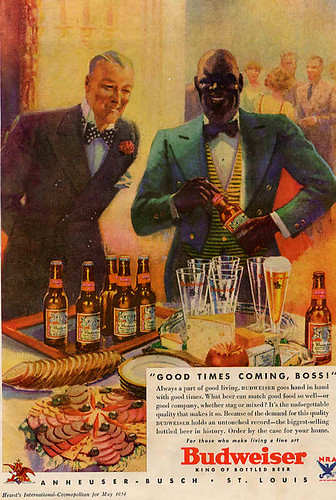
This is an old Budweiser ad from 1934, click on it for a larger view (hat tip to copyranter). The tagline reads “Good times coming, boss!”The white man smirks at the camera, bending over slightly to supervise as his black manservant serves up some Bud and cold cuts for the guests.
 And the "Zagar and Steve" commercial isn't only recent commercial that's smacked of racism by Budweiser. In a blog done on Counter Punch by David Zirin, Zirin goes on to describe a Budweiser ad about a whiney sports star:
"Leon" is Bud's big joke parody of the modern professional athlete. "Leon" won't do interviews unless his special dimple is on display. "Leon" is far more concerned about looking "pretty" than playing well. "Leon" is egomaniacal, lazy, and all about the bling-bling. "Leon" only speaks in the third person. Oh by the way, "Leon" is Black.Zirin goes on to write:
"Leon" is supposed to be a harmless caricature, but of whom?...So who is "Leon"? "Leon" is corporate America's gob of spit in the face of modern Black athletes and anti-heroes. They are striking not only the players themselves, but also us--the fans-for embracing them. We shouldn't accept that. Let's load "Leon" on a bus with Stepin Fetchit, Mammy, Charlie Chan, and that damn Taco Bell Chihuahua--and push it off the pop culture cliff. Until "Leon" goes, Guinness will suit me just fine.Images From:
Newspaper Rock
Conscious Media Maker
Subscribe to:
Posts (Atom)


